ARBELLA MATHAMS
ANIMATION PORTFOLIO
Creating Horatio Bean - A Short Film
My Group Contributions
Primary Role – Animation
Secondary Role – Effects
Tertiary Roles – Retopology, UVing & Texturing
Animation
I executed all the animation work in the project including all models of Horatio, side characters, environment animation and camera angles and movements.
When developing Horatio's actions over time, I focused on keeping his movements consistent with little movement, whilst still showing subtle signs of life.
He's a fairly still character, however I did not want him to be completely static, so I introduced small, controlled motions that carry through into his adulthood. As he ages, his posture gradually deteriorates, with a more noticeable curve on his back. His thumbs are the most active part of his body.


The side characters were more challenging to animate, however the most exciting, because their performances relied heavily on exaggerated body language, as their faces are never shown.
This meant their actions had to clearly communicate emotion. In one scene, his mother slams a plate in front of him. I wanted to show her shift from irritation to frustration: first through her posture with her hand on her hip as she realises that he's not acknowledging her, and then through the forceful action of slamming the plate down.
The camera remains focused on Horatio, with his mother entering the frame only partially. Her face stays out of view to reflect his lack of awareness of others around him.
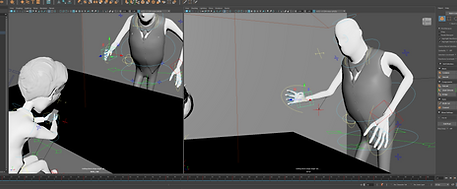
Another challenge was animating the boss in the firing scene.
I spent time during the research and development stage practicing this performance, using recorded references to capture the right level of anger.
I also communicated with the rigger, requesting an upper-body IK setup so the animation would feel more grounded – particularly to ensure that his fists remained planted when he hits the table, and especially when he jolts back.



The final scene took the most time to refine.
I animated the screens into frame in front of Horatio to show his fixation, using a smooth camera movement and controlled pacing to emphasise how consumed he is. I needed to reflect his life on screens in this scene most of all.
It is a significant scene overall, especially when Horatio finally puts his phone down. The pacing needed to feel deliberate, so I avoided rushing the action of his hand leaving the phone. I wanted his gradual realisation – that he's been missing out on his life – to come through clearly.
Opening Scene
For the opening scene, I handled the entire process independently using Maya, Photoshop, and Premiere Pro. Since I already had the textures and assets that were made for other scenes, I focused on creating the scene in Maya, where I animated the camera, set up and animated the lighting, and rendered the sequence.
I then brought that footage into Premiere Pro to refine the overall look, using Lumetri Colour to correct the tonality and achieve the visual style I was aiming for, as the initial lighting did not fully translate in the render.
For the text and glow effect emerging from the phone, I used Photoshop. I created multiple variations to produce a glitch effect, which I then passed on to the compositor/editor, who integrated it in the film and added sound.


Reflection
Working on this project taught me massively about how important teamwork and communication are. I have learnt more about the aspects which affect the pipeline, and how the quality of one part can affect everything that follows.
It also made me realise how important it is to ask for help when you're struggling, as staying silent can negatively impact everyone else. This also offers a learning opportunity which can be applied in the future and prevent mistakes.
I have gained a clearer understanding of the depth of how roles connect – for example, how the topology impacts rigging and texturing, which then of course impacts the animator.
Whilst working on retopology, I not only spoke with our rigger but also spoke with riggers outside of my group to check that it would be easier to work with, especially in areas where the character would need to move more. Later, as an animator, I was also able to communicate what I needed from the rig, which helped improve my final result.
I am proud that, as a team, we completed the project without cutting major elements and keeping our sixteen environments. Due to clear communication, we were able to maintain a strong level of collaboration and produce a solid outcome.
This may have been contributed by the fact that after working for so long with this group, I developed a sense of their strengths and weaknesses and so was able to spread the work and ask them to take on tasks I knew they could execute well and quickly.
Towards the end of the project, our director was away and so I, along with the producer, took on the role of allocating tasks. I was getting in contact with everyone almost every day and so no one was confused about what they were doing. They also felt comfortable asking for my advice.
Furthermore, I became more confident in giving feedback as the project progressed, especially towards the end where I was helping to refine the work where I saw fit. I also felt comfortable asking for others' opinions on my quality of work.
Overall, this experience gave me valuable insight into the pipeline, teamwork, and my own development in skills, whilst also helping me discover new interests that could potentially affect my future pathway.
